




How-To & Care — Bathroom Faucets
Why Is My Bathroom Faucet Dripping? Find the Cause and the Fix
A dripping bathroom faucet is telling you which part has worn out, if you know where to look. Here is how to read the drip, fix it in the right order, cheapest first, and recognise the day a new faucet is the smarter repair.


Water should leave a faucet in one place, on purpose. Anywhere else is a clue.
In short: Most bathroom faucet drips trace back to one worn part. Water dripping from the spout means worn cartridge seals or, on older two-handle faucets, a hardened rubber washer; water pooling around the handle means a tired O-ring; water inside the vanity means a supply connection. Shut off the supply stops, fix the cheapest likely part first, and replace the whole faucet if the body is corroded or the drip keeps returning. It is worth doing soon: the EPA says a faucet dripping once per second can waste more than 3,000 gallons a year.
- Where the water appears (spout, handle, base or cabinet) points to the part that failed.
- A drop or two right after shut-off is the spout draining, not a leak. Wait a minute before you judge.
- Always close the supply stops and open the faucet to drain it before you take anything apart.
- Work from the cheapest fix up: aerator, connections, O-rings, cartridge, then the whole faucet.
- A corroded body, a drip that returns after a new cartridge, or parts you cannot match all say replace.
Read the drip
Where exactly is your faucet leaking?
Start with location, because location is diagnosis. A faucet holds water back in only a few places: the valve, the O-rings around the moving parts, the gasket under the base and the connections underneath. When one wears, the water shows up next to it.
So before you buy a part, dry the faucet, run it for ten seconds, shut it off and watch. Lay a dry paper towel on the deck and another on the cabinet floor; wherever a towel darkens first is your answer. The symptom finder covers the eight patterns we hear about most.
Two of those rows are not faucet faults at all: the draining-spout drop is normal, and many "faucet leaks" under the vanity are a supply-line nut nudged loose by a stored bottle. Rule those out and the list gets short fast.

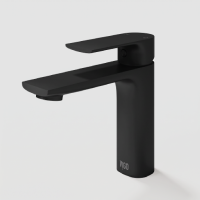
On a single-lever faucet like the Davidson, one cartridge does all the work, so a spout drip almost always points to it.
Know your valve
What kind of faucet valve do you have?
You need to know the valve type because it decides which part you buy. Residential faucets use one of four designs, and the City of Calgary's water-conservation guide to repairing faucets sorts them neatly: washer-type compression valves, cartridges, ball valves and ceramic discs.
The handle is the quickest tell. A two-handle faucet whose handles keep turning and feel progressively tighter as they close is almost certainly a compression design: a rubber washer squeezes down onto a metal seat, and over the years the rubber hardens and the seat pits. A handle that travels a quarter or half turn from off to full and then stops is a cartridge or ceramic-disc valve. A single lever riding on a rounded cap is often a ball valve.
A widespread faucet like the Cass below has two valves, one under each handle, so it can drip from one side only. That is useful: feel the drip. Warm means the hot valve, cold means the cold one, and you have halved the job. If you are not sure what is under your handles, our VIGO faucet parts, care and support guide walks through identifying parts on a VIGO faucet.

Two handles, two valves: a widespread faucet like the Cass can drip from one side while the other stays perfectly dry.
Fix it in order
What should you try first to stop the drip?
Try the cheapest, least invasive fix that matches your symptom, then climb. Every step below costs more time or money than the one before it, and most drips are solved by the third or fourth rung.
Before any step that opens the faucet body, do the safe setup: turn both shut-off valves under the sink clockwise until they stop, then open the faucet to relieve pressure and drain what is left in the lines. Push a rag into the drain opening so a set screw cannot vanish, and photograph each part as it comes off so it goes back the same way. If a shut-off valve will not close, leaks at its own stem, or the water is coming from the wall rather than the faucet, stop there and call a licensed plumber.
Confirm it is a real drip
Shut the faucet firmly but gently, wait a full minute, then watch. Overtightening a handle to stop a drip only grinds a worn washer or seat harder, so resist the urge.
No toolsTwo minutesClean or replace the aerator
Unscrew the tip of the spout (wrap it in a cloth if you need pliers), soak the screen in white vinegar to dissolve scale, rinse and refit. It cures sputtering, sideways spray and slow dribbles off the spout.
Vinegar soakHandle off, water onSnug the connections underneath
For cabinet drips, tighten each supply-line nut about a quarter turn with an adjustable wrench, no more. Replace any braided line that is kinked, rusty or bulging rather than coaxing it along.
Adjustable wrenchQuarter turnReplace the O-rings
For water around the handle or spout base, remove the handle, lift out the cartridge or stem, roll off the old O-rings and fit new ones with a thin film of plumber's grease.
Supply stops offO-ring kit and greaseReplace the cartridge, or the washer and seat
For a steady spout drip, take the old cartridge with you so the replacement matches exactly, and note which way it faced. On compression valves, a new washer often needs a new or dressed seat to go with it.
Supply stops offExact-match partReplace the faucet
When the body is corroded, the drip returns after a new cartridge, or you cannot find parts, a new faucet is the real repair. New supply lines go in at the same time.
Afternoon projectNew supply linesTimings on the chips are our editorial estimates; scaled-up old faucets always take longer. Follow your faucet's own installation or parts instructions over any general guide, this one included.
Why it matters
How much water does a dripping faucet really waste?
More than it sounds. The EPA's WaterSense program, during its annual Fix a Leak Week, puts a faucet dripping once per second at more than 3,000 gallons a year, and estimates the average household's leaks at more than 9,300 gallons a year. A drip is small; a year of drips is a bathtub filled many times over and poured away.
A hot-side drip costs twice, for the water and for heating it. And a slow cabinet leak can swell particleboard long before anyone notices, which is why the dry-towel test is worth doing even when you see nothing.
While you are thinking about water, look at the aerator's flow rating. WaterSense says a standard bathroom faucet flows at 2.2 gallons per minute, while WaterSense-labeled bathroom faucets use a maximum of 1.5. VIGO's current bathroom faucets list a Performance Spout™ 1.2 GPM aerator in their product descriptions.

A stone vanity shrugs off splashes; the cabinet underneath is where slow leaks do their damage.
Repair or replace
When is a new faucet the better repair?
Replace the faucet when the problem is the body rather than a part. A cartridge is a consumable; a body is not. Green or white corrosion where the spout meets the deck, a finish worn through at the handle, or a drip back within weeks of a correct cartridge swap all say more parts will not buy much time.
- Parts you cannot match. An unbranded or discontinued faucet can turn a twenty-minute cartridge swap into a week of hunting.
- Multiple failures at once. A spout drip, a weeping handle and a stiff lever together usually mean everything inside is the same age.
- A remodel already planned. If the vanity or top is changing soon, a stopgap repair now and a new faucet then is perfectly reasonable.
Our bathroom faucet replacement cost guide lays out what the swap typically runs, and the job itself is well within reach for a careful DIYer; our step-by-step faucet install guide covers single-hole and widespread versions.
If you do replace, match the faucet to the holes you already have. A single-hole faucet suits one opening; a widespread needs three. Most VIGO single-hole and vessel faucets list EZ Install™ for a 1-3/8 in. opening with 3/8 in. connections, and the Linus vessel faucet's description specifies a Sedal ceramic cartridge tested for over 500,000 uses. For help with a VIGO faucet you already own, VIGO support is at 866-591-7792.
Featured in this story
If the drip says replace
Davidson Single Hole Bathroom Faucet — the straight swap
A 6 in. H single-lever faucet with a 4 in. spout height and 5 in. reach, made for the one-hole vanity you already have.
From $109.90
View product
Amada Single Hole Bathroom Faucet — the upgrade
An open-channel waterfall spout, 7 in. tall with a 5 in. spout height and reach, in four finishes.
From $124.90
View product
Cass Widespread Bathroom Faucet — for three-hole vanities
Dual handles for independent hot and cold control, 8 in. tall with a 5 in. spout height and 6 in. reach.
From $144.90
View product
Linus Vessel Sink Faucet — for a vessel sink
8 in. tall with a Sedal ceramic cartridge tested for over 500,000 uses, in matte black, brushed nickel or chrome.
From $114.90
View productShop these categories
Explore the rangeBathroom Faucets
Single-hole, widespread and wall-mount faucets in four finishes.
Shop Bathroom FaucetsReference
Questions, answered
Will a new aerator stop a dripping faucet?
Usually not. The aerator only shapes the stream at the tip of the spout; a true drip comes from the valve inside the body. A clogged aerator can make a faucet sputter or dribble briefly after shut-off, so cleaning it is still a worthwhile first step.
Why does my faucet drip only when the handle is in certain positions?
That usually means worn seals inside the cartridge, which hold in some handle positions and not others. A handle that is not fully seated on its stem can do the same, so check the set screw before buying a new cartridge.
Do I need to shut off the main water to fix a bathroom faucet?
Usually not: the two shut-off valves under the sink isolate the faucet. If those valves will not close fully or leak at their own stems, shut off the main and consider having a plumber replace the valves.
Should new O-rings be greased?
Yes. A thin film of faucet-safe plumber's grease helps new O-rings slide into place without tearing and keeps the handle moving smoothly. Use only a little; excess grease collects grit.
Can a dripping faucet fix itself?
Not for long. Mineral scale can occasionally plug a worn seal and slow a drip, but the seal is still worn and the drip almost always returns, often worse.
Is a hot-water drip more urgent than a cold one?
A little. Every hot drip is water you have already paid to heat, so it costs energy as well as water. The repair is the same either way: the valve on the hot side.
Further reading
A quiet faucet is a fixed faucet
Most drips are one worn part and an hour of patient work. When the faucet itself has had its day, choose one that fits the holes you already have and enjoy the silence. Start with our bathroom faucet collection.


