



Buying Guides — Kitchen Faucets
Kitchen Faucet Holes Explained: What Fits a 1-, 2-, 3- or 4-Hole Sink
Before you fall for a faucet, count the holes it has to live with. Their number, size and spacing, plus the thickness of the counter, decide what fits, and every hole the faucet doesn't use still needs a plan: a deck plate, a soap dispenser or a cover.


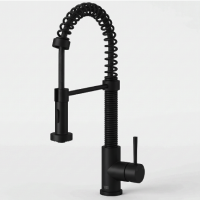
One faucet, one hole: a matte black Edison pull-down on its deck plate, set into a wood island top.
Most single-handle kitchen faucets need just one hole, about 1-3/8 in. across, and every other hole in your sink is a choice. A single-hole faucet fits a 2-, 3- or 4-hole sink once you deal with the rest: a 10-in. deck plate (an escutcheon) hides the outer holes of a 3-hole sink drilled on the common 8-in. spread, and a soap dispenser, filtered-water tap or hole cover takes any spare. Before you buy, measure four things: hole count, hole diameter, the center-to-center span of the outer holes and the thickness of the counter at the hole.
01 — Count Your Holes
How many holes does a kitchen faucet need?
Usually one. Most single-handle pull-down and pull-out faucets mount through a single hole; VIGO's Edison and Greenwich pull-downs, for example, each list one installation hole. Any other hole in your sink was put there for something else: an old two-handle faucet, a side sprayer, a soap dispenser, or nothing at all.
So the useful question isn't whether a faucet fits, but what you'll do with the holes it doesn't use. Here is what each pattern means, whether you buy a lever faucet or a touchless kitchen faucet.
02 — Measure Four Numbers
What size is a standard kitchen faucet hole?
About 1-3/8 in. across. Hunker gives that as the standard diameter and notes that some faucets need a 1-1/2 in. hole. It is also the size VIGO publishes for the Edison and the Greenwich, along with 3/8 in. supply connections. Dispenser holes vary more; VIGO's Bolton and Bristol take a 1-1/4 to 1-1/2 in. opening.
Hole size is one of four numbers to measure before you buy. Write all four down and check each one against the spec sheets of the faucet and accessories on your list.
The last number is the easiest to forget. Maximum deck thickness is how much material the faucet's mounting hardware can clamp through: the sink deck or countertop, plus any plywood or support underneath. Treat it as a hard limit. If you are still choosing the faucet itself, our pull-down kitchen faucet guide covers spout height, spray modes and reach.
03 — Deck Plates
Can you put a single-hole faucet on a 3-hole sink?
Yes, with a deck plate. A deck plate (the trade term is escutcheon) is a long, flat cover that sits under the faucet base. The faucet passes through the middle hole and the plate hides the two outer ones. On many 3-hole kitchen sinks the outer holes sit 8 in. apart, center to center, which is why kitchen plates tend to run about 10 in. long. Delta, for instance, rates its 10-in. kitchen escutcheon for 3-hole, 8-in. installations.
VIGO sells the Edison Kitchen Deck Plate as a 10-in. plate; its dimension drawing shows 9-7/8 in. long and 2-3/8 in. wide, and the product page lists holes up to 1-1/2 in. in diameter. Do the edge-to-edge math before you order: 1-3/8 in. holes on 8-in. centers span 9-3/8 in. from outer edge to outer edge, which the plate covers. The plate ships with its mounting hardware and is offered in matte black, matte brushed gold, stainless steel and chrome.

A matte black Edison on its deck plate: one clean footprint, outer holes out of sight.
Two cautions. First, check whether your faucet already comes with a plate. The Edison and Greenwich pull-downs both list "Deck plate included: No," and the Greenwich page says plainly that a 3-hole sink needs one, sold separately. Add the Edison plate if your faucet doesn't include one. Second, no deck plate fits everything. It has to span your outer holes, and its center opening has to suit your faucet's base. VIGO pairs the Edison plate with its own single-hole kitchen faucets; with any other brand, check the numbers first.
04 — The Spare Hole
What do I do with the extra hole in my kitchen sink?
Give it a job, or close it neatly. You have four realistic options.
Our default is the soap dispenser. A bottle of dish soap is the clutter nearly every sink ledge collects, and a dispenser in the spare hole gets rid of it for good. A pull-down faucet's spray head has already replaced the old side sprayer, so there's little reason to put one back.
One hole deserves a second look before you cap it: a dishwasher air gap is part of your plumbing, not a spare. Fresh Water Systems notes that many U.S. plumbing codes require one, and that where they don't, a high loop under the sink is the usual alternative. Ask your local building department before you remove or plug it.
05 — Soap Dispensers
Where should a kitchen soap dispenser go?
Put it on the side of your dominant hand, in whichever hole keeps it clear of the faucet's handle and hose. For most right-handed cooks that is the hole to the right of the faucet. Left-handed cooks often prefer the left. Three checks settle the exact spot:
- Handle swing. You should be able to work a single-handle lever through its full range without knocking the pump.
- Hose path. A pull-down spray head comes back down and docks. Keep the dispenser where the hose won't drag across it.
- Reach. VIGO's Bolton and Bristol dispensers both have a 3-1/2 in. spout that swivels 360 degrees, so you can aim the soap over the basin instead of the counter.
Then match the dispenser to the hole and the counter. Both fit a 1-1/4 to 1-1/2 in. opening and hold 10 oz. The Edison Bolton mounts through decks up to 2-3/4 in. thick; the Bristol's page lists counters up to 1-1/2 in. Both are top-fill designs, so you refill from above the counter instead of reaching into the cabinet. On the Bristol, VIGO's instructions are simply to lift the pump head and pour.
06 — No Holes Yet
Do undermount sinks have faucet holes?
Usually not. An undermount sink hangs beneath the countertop, so the faucet and accessory holes are drilled through the counter itself. That means you choose the hole count, not the sink maker, and you need to choose before the fabricator's template visit. Ask for one hole for the faucet and one for a dispenser, plus one for an air gap if your local code calls for it. Bring the faucet's spec sheet so the diameter and spacing are right. Drilling stone and quartz is the fabricator's job, and a hole in the wrong place is permanent.
Then check thickness, where counters and faucets can quietly disagree. MSI sells its quartz in 2 cm (3/4 in.) and 3 cm (1-1/4 in.) slabs, and notes that a 2 cm top may need extra plywood for support. Every layer under the hole counts toward the faucet's limit. Wood is the other material to watch. Grothouse, a wood-countertop maker, gives 1-1/2 in. as the minimum thickness for its edge-grain tops and 2-1/2 in. for end-grain butcher block.
Compare those with the specs. The Edison and Greenwich pull-downs list a 1-1/2 in. maximum deck thickness. A 3 cm slab on its own fits within that, but thick wood or a built-up substrate may not. The Edison Bolton dispenser allows up to 2-3/4 in. If your counter is close to a limit, measure at the actual hole location before you order. To budget for the swap itself, see our kitchen faucet replacement cost guide.
Featured in this story
One hole, three pieces
Edison Kitchen Deck Plate
A 10-in. plate (9-7/8 in. on the drawing) for 3-hole sinks with holes up to 1-1/2 in.
From $24.90
View product
Edison Pull-Down Kitchen Spray Faucet
Single 1-3/8 in. hole, 1-1/2 in. max deck, dual-action spray head.
From $174.90
View product
Edison Bolton Kitchen Soap Dispenser
Fits a 1-1/4 to 1-1/2 in. hole, mounts through up to 2-3/4 in. and refills from above.
From $34.90
View productShop these categories
Explore the rangeBathroom Faucets
Single-hole and widespread faucets: the same hole math at vanity scale.
Shop Bathroom FaucetsVessel Sinks
For the bath: glass, matte stone and concreto bowls that sit on the counter beside a tall single-hole faucet.
Shop Vessel SinksReference
Questions, answered
Is a deck plate the same thing as an escutcheon?
Yes. Escutcheon is the general trade term for a decorative plate that covers a hole around a fixture. In a kitchen it usually means the long plate under the faucet that hides the outer holes of a 3-hole sink, and retailers use deck plate, escutcheon and base plate interchangeably.
Do VIGO kitchen faucets come with a deck plate?
Check the individual listing. The Edison and Greenwich pull-downs both list "Deck plate included: No," so on a 3-hole sink you would add the Edison Kitchen Deck Plate, which VIGO sells separately in four finishes.
How far apart are the holes on a 3-hole kitchen sink?
Usually 6 or 8 in., measured center to center across the two outer holes; Hunker lists both as standard on three- and four-hole kitchen sinks. Measure yours before you choose a plate.
Do I still need a side sprayer with a pull-down faucet?
Not usually. The pull-down spray head does the side sprayer's job; the Edison's, for example, switches between an aerated stream and a spray at the press of a button. The old sprayer hole is better used for a soap dispenser.
My sink holes are 1-1/2 inches and the faucet calls for 1-3/8. Will it work?
Often, yes: the faucet's base sits on top of the hole and its mounting hardware clamps from below, so a slightly larger hole can still work. Confirm on the spec sheet that the base fully covers the hole, and if you're unsure, ask the faucet maker before you install.
Can I drill an extra hole for a soap dispenser myself?
Not in stone or quartz. Leave that to your fabricator, who has the right tools and knows where the slab can take a hole. For any other surface you're unsure about, call a plumber, because a misplaced hole can't be undone.
Will a single-handle pull-down faucet fit my 4-hole kitchen sink?
Yes. Mount the faucet in the middle of the three main holes with a deck plate over the outer two, and give the fourth hole a soap dispenser, filtered-water tap or cover. Check that the plate spans your outer holes and that the sink deck is within the faucet's maximum deck thickness.
Further reading
Four numbers, one faucet
Once you have your four numbers (hole count, diameter, span and counter thickness), the shopping is simple: a single-hole faucet, a plate if you need one, and a dispenser for the spare hole.


