






How-To & Care — Shower Glass
Spots, Scum or Etching? How to Tell What's on Your Shower Glass and Fix It
Not every cloudy shower door has the same problem. A dry fingernail and a splash of white vinegar will tell you whether you're looking at minerals, soap, rust, mildew or the one mark no cleaner can lift — and what actually works on each.


Dark tile behind clear glass is honest: it shows every spot. That makes it the perfect place to learn the difference between them.
At a glance
Most cloudy shower glass is carrying something on its surface, not damage in it. Chalky white dots that soften under white vinegar are hard-water minerals; a greasy grey film that smears under a finger is soap scum; orange streaks are iron; black specks along the seals are mildew. If the haze is smooth, doesn't catch a dry fingernail and survives both a vinegar soak and a soap-scum cleaner, the glass itself is probably etched — surface corrosion that cleaning can slow down but never reverse.


Glass, chrome and marble share one shower and three different reactions to hard water — which is why one cleaner rarely suits all of them.
01 — The Chemistry
Why does shower glass get cloudy in the first place?
Because water is never just water. The USGS Water Science School defines hardness as the amount of dissolved calcium and magnesium in water, and notes that calcium reacts with soap to form soap scum. Every time a droplet dries on your door, the water leaves; the minerals stay.
That gives you three layers of trouble, from easiest to hardest. First, deposits sitting on the glass: mineral spots, rust, mildew. Second, films bonded loosely to it: soap scum and the body oils that ride along with it. Third, damage in the glass itself. Glass maker Pilkington notes that glass exposed to water, heat and humidity can corrode over time, reducing its natural transparency — which is a fair description of a shower.
The good news: the first two layers account for most cloudy doors we hear about, and they come off. The trick is identifying which one you have before you start scrubbing.
02 — The Specimens
What is that on my shower glass?
It is almost always one of six things. Look at where the mark sits, what color it is and how it behaves under a dry fingertip, then match it below. The dots rate how removable each one is: five means it wipes away with the right cleaner; one means it is in the glass, not on it.
Specimen 01
Hard-water spots
How to tell: chalky white dots and rings, heaviest in the lower third and wherever the shower head sprays. They feel faintly gritty, fade when the glass is wet and reappear as it dries.
What removes it: white vinegar or a descaler labelled safe for glass, given time to work, then a non-scratch pad, a rinse and a dry.
Specimen 02
Soap scum
How to tell: a dull, greasy grey-white film at hand and shoulder height. Run a finger through it and it smears or leaves a clear track; water on it looks flat instead of beading.
What removes it: warm water with a grease-cutting dish soap, or a bathroom cleaner labelled for soap scum. Vinegar alone struggles with the oily part.
Specimen 03
Mineral film
How to tell: what spots become when nobody dries the glass for a year. An even, milky haze across the whole panel that feels like very fine sandpaper under a dry fingernail.
What removes it: repeated acid treatments — vinegar compresses or a glass-safe descaler — with patience. Expect two or three rounds, not one heroic scrub.
Specimen 04
Etching
How to tell: a smooth, permanent haze — sometimes a ghost of the old spot pattern. A dry fingernail glides straight over it, vinegar changes nothing, and it nearly disappears when the glass is wet.
What removes it: nothing in a spray bottle. A glass professional can say whether restoration is worth trying; often replacement is the honest answer.
Specimen 05
Rust and iron stains
How to tell: orange or brown streaks and drips, usually below a metal can, a forgotten razor or a corroding caddy, or across the whole door if your water comes from an iron-rich well.
What removes it: a rust-stain remover labelled safe for glass, used exactly as directed — then remove whatever metal is shedding it.
Specimen 06
Mildew on seals
How to tell: black or grey specks, sometimes with a pinkish slime, living in the clear vinyl seal strips, the bottom sweep and the silicone joints rather than on the glass face.
What removes it: detergent, water and a soft brush, then dry thoroughly. Seal strips that stay stained can simply be replaced.
Still not sure? That's normal — an old door can carry three of these at once, stacked like sediment. The two tests in the next section will sort them out in about twenty minutes.


Test on the glass, not the handle: keep vinegar and descalers off metal finishes, and rinse right away if they touch.
03 — The Tests
How do you tell etching from buildup?
Use a dry fingernail first, then a vinegar compress. Together they separate "something on the glass" from "something wrong with the glass" with surprising reliability.
The fingernail test. Dry a hazy patch completely with a microfiber cloth. Drag a fingernail slowly across it. If the nail catches, drags or feels gritty, there is a deposit sitting on the surface — good news. If it glides as smoothly as it does on clear glass while the haze stays put, suspect etching.
The vinegar test. Soak a folded paper towel in plain white vinegar and press it onto a palm-sized test patch so it clings. Leave it for about 20 minutes (our editorial rule of thumb), then wipe with a non-scratch pad, rinse and dry. If the patch cleared, it was minerals. If it didn't, try a soap-scum cleaner on the same spot. Haze that survives both is very likely etching.
Safety first: keep vinegar and acid cleaners off natural stone such as marble, travertine and limestone, which acids can dull; wear gloves; ventilate; and never mix cleaners — the EPA warns that chlorine bleach combined with ammonia-containing products can produce toxic fumes.
04 — The Fixes
What removes each kind of mark on shower glass?
Start gentle and go up a step only when the gentle method has had a fair chance. Most damage we see on otherwise healthy glass comes from the wrong tool used in frustration — a scouring powder, a green pad, a blade dragged across a coating.
For the routine side of things — the weekly clean, the right cloths, what to keep in the shower caddy — our step-by-step guide on how to clean glass shower doors and keep them clean picks up where this diagnosis leaves off.
05 — Prevention
How do you stop shower glass from etching?
Keep water from drying on it. Etching is slow; it builds over months of minerals and moisture sitting on the surface, so the habits that stop spots also protect the glass underneath.
- Squeegee after every shower. Thirty seconds, top to bottom, while the glass is still warm and wet. It removes most of the mineral-laden water before it can dry.
- Vent the steam. The EPA's guidance on mold is blunt: the key to mold control is moisture control. Run the exhaust fan or open a window, and leave the door ajar so the seals dry.
- Clean little and often. A weekly mild clean stops soap film hardening into a crust that tempts you toward abrasives.
- Know your water. The USGS scale below is measured as calcium carbonate. If you are in the hard or very hard bands, a whole-house water softener reduces how much there is to dry on the glass.
- Choose glass that sheds water. A factory-applied easy-clean treatment won't make glass self-cleaning, but it helps water and soap let go.
When a panel is genuinely etched, be realistic. Tempered glass cannot be cut, drilled or reground after tempering, so there is no trimming out the bad section; a fix means a new door or a factory-made replacement panel. Glass panels are heavy and unforgiving, so handle them with two people and gloves, follow the product's own installation manual, and call a licensed glazier if anything about the opening looks out of square.
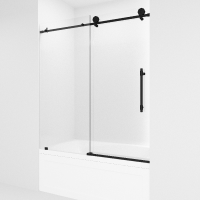
If you are replacing, it is worth weighing the glass as carefully as the hardware. VIGO offers ProtecGlass™ as a glass option on the Elan Sliding Frameless Tub Door, and the Elan tub door bundles describe their 3/8 in. (10 mm) certified ProtecGlass as built for easy cleaning. Our explainer ProtecGlass, Explained covers how it compares with other glass protection, and the guide to types of shower glass explains why fluted and frosted glass are kinder to busy households: texture disguises the odd spot that clear glass puts on display.
Featured in this story
Glass that's easier to keep clear
Elan Sliding Frameless Tub Door
For 56 to 60 in. alcove tubs, with ProtecGlass™ among its glass options and a four-wheel Roller-Disk glide.
From $839.90
View product
Elan Frameless Sliding Shower Door
Openings from 44 to 48 in. up to 68 to 72 in., with clear, fluted, frosted and privacy glass among its options.
From $839.90
View product
Luca Frameless Sliding Shower Door
Clear 3/8 in. certified tempered glass, clear seal strips and a 7-layer finish on stainless steel and brass hardware.
From $759.90
View product
Hamilton Frameless Sliding Shower Door
Two panels of 3/8 in. certified tempered glass with continuous seal strips and corrosion-resistant stainless steel hardware.
From $1,079.90
View productShop these categories
Explore the rangeShower Doors
Sliding, hinged and pivot doors in clear, fluted and specialty glass.
Shop Shower DoorsShower Enclosures
Corner, rectangle and neo-angle glass enclosures, with or without a base.
Shop Shower EnclosuresReference
Questions, answered
Can etched shower glass be repaired?
Not with cleaners. Etching is damage to the glass surface rather than something sitting on it, so a glass professional can tell you whether restoration is worth attempting, but replacing the panel or door is often the practical answer.
Is it safe to scrape shower glass with a razor blade?
It is risky: a blade can scratch the glass or strip a factory easy-clean treatment. Try vinegar compresses and a non-scratch pad first, and check your door's own care instructions before using any blade.
Will a water softener stop spots on my shower door?
It reduces them, because softening removes much of the calcium and magnesium that dries into spots. Droplets can still leave a light residue, so a quick squeegee remains the best habit.
Why do the spots come back right after I clean?
Cleaning removes yesterday's minerals, but every shower brings a fresh supply. Unless the glass is dried afterward, the next layer of spots starts forming as soon as the door air-dries.
Is vinegar safe for shower door hardware and seals?
Brief contact followed by a thorough rinse is generally fine on glass, but keep vinegar off metal finishes and seals as much as you can, and never use it on marble or other calcium-based stone. When in doubt, test a hidden spot and follow the product's care guide.
Does easy-clean glass mean I never have to squeegee?
No. An easy-clean treatment helps water and soap release so cleaning is quicker, but minerals still dry on any glass left wet. Use gentle cleaners on treated glass, since aggressive products can damage the coating.
Further reading
Clear glass is a habit, not a miracle
Identify the mark, use the gentlest thing that works, and give the glass thirty seconds with a squeegee after every shower. If it's already etched, a new door with easy-clean glass is a fresh start — browse our shower doors.


