




How-To & Care — Kitchen Faucets
Low Water Pressure in a Kitchen Faucet? 7 Causes, Easiest Fix First
A weak kitchen faucet is usually one small blockage, not a plumbing crisis. Here is how to tell whether the problem is the faucet or the house, and the seven fixes worth trying, in the order a sensible plumber would.


Most weak streams are decided in the last two inches of the spout, or the two feet of hose under the sink.
In short: If only your kitchen faucet is weak, the cause is almost always at the faucet: a clogged aerator or spray-head screen, a shut-off valve left partly closed, a kinked pull-down hose or supply line, or debris in the cartridge, in that order of likelihood. If every tap in the house is weak, look at the main valve, the pressure regulator or the utility instead. And remember that modern faucets are flow-limited by design: federal rules cap kitchen faucets at 2.2 gallons per minute at 60 psi, so a calm stream is not always a fault.
- Run another tap first. One weak faucet is a faucet problem; a weak house is a supply problem.
- Hot-only weakness points to the hot shut-off, hot supply line or the hot side of the cartridge, or the water heater if every hot tap is weak.
- Sprayer-only weakness points to the spray head; both modes weak points further back.
- Pressure that dropped right after plumbing or water-main work usually means sediment knocked loose into the aerator or cartridge.
- A new pull-down faucet is the fix only when the faucet itself is worn, not when the house is starved.
01 — Triage
Is it the faucet or the whole house?
Find out in two minutes by running other fixtures. Open the bathroom sink and a tub spout, then go back to the kitchen. If they are all lazy, your faucet is innocent and the problem is upstream. If the kitchen is the only one struggling, you can stop worrying about pipes in the wall and focus on the last few feet of plumbing.
Then narrow it with three more questions: is it hot, cold or both; is it the spray, the stream or both; and did it happen suddenly or fade over months? Gradual decline is scale building up. A sudden drop, especially right after a repair or a water-main flush on your street, is debris on the move. The finder below turns those answers into a starting point.
02 — The seven fixes
What are the 7 causes of low kitchen faucet pressure, easiest first?
Work down this list in order and stop when the stream comes back. The first three need no parts at all; only the last one involves anyone else. For any step that opens the faucet, close both shut-off valves under the sink first and open the faucet to drain it.
Open the shut-off valves fully
After any repair, cabinet clear-out or new install, a stop left a half-turn closed is the most common culprit there is. Turn both counterclockwise until they stop. If a valve is crusty and will not move, do not force it; that is a job for a plumber.
No toolsOne minuteClean the aerator or spray head
Unscrew the aerator (on many pull-downs the spray head itself unscrews from its hose; your manual will say) and look at the screen. Scale and grit collect here first. Soak the parts in white vinegar, rinse and refit; replace the aerator if the screen is torn or packed solid.
Vinegar soakNo shut-off neededFree the pull-down hose
Under the sink, the hose should hang in a smooth loop with its weight free. Bins and cleaning bottles push it into kinks, and a weight snagged on a supply line pinches the flow. Straighten it, then pull the spray head out and let it retract to check.
Clear the cabinetNo partsCheck the supply lines and quick-connect
Flexible supply lines can kink or crimp as they age. Look for flattened sections, and make sure the hose's quick-connect fitting is fully seated as its instructions describe. Replace a deformed line rather than bending it back.
Supply stops offNew lines if kinkedClean or replace the cartridge
If the aerator and lines are clear, debris may be lodged in the valve. With the stops closed, remove the handle and cartridge, then hold a bucket over the open body and crack each stop briefly to flush grit out. Clean or replace the cartridge with an exact match.
Supply stops offExact-match partCheck whether it is the design, not a fault
Compare the faucet's rated flow with what you are used to. A faucet built to today's limits will feel gentler than a decades-old one. That is engineering, not a clog, and removing a restrictor is not the answer.
Read the specNo toolsLook at the whole house
If every fixture is weak, check that the main shut-off is fully open, then ask a licensed plumber to test the pressure and inspect the pressure-reducing valve and old supply piping. Ask your neighbours too; the utility may already know.
Licensed plumberUtility callTimings on the chips are our editorial estimates. The City of Calgary's guide to repairing faucets recommends the same vinegar soak for a mineral-clogged aerator, and the same rule before any repair: shut off the supply and drain the faucet first.

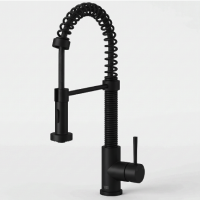
On any pull-down, the aerator, the spray face and the hose under the sink are the first three places to look.
03 — One side only
Why is only the hot water weak at my kitchen faucet?
Hot-only weakness means the restriction sits somewhere on the hot path, and there are only four candidates. Test them in order, from easiest to reach to hardest.
- The hot shut-off valve. It may simply be partly closed, or its old washer may be breaking up inside.
- The hot supply line. A flattened or kinked braided line restricts one side only.
- The hot side of the cartridge. Hot water carries more dissolved scale out of the heater, so debris tends to gather here first.
- The water heater. If the bathroom's hot water is weak too, the faucet is innocent. Sediment at the heater is a job for its maker's manual or a plumber.
A quick test: unscrew the aerator and run hot only. If it is still weak with the aerator off, the problem is behind the spout, so move on to the stop and the line.
04 — Flow versus pressure
Is a low-flow kitchen faucet the same as low pressure?
No. Pressure is the push in your pipes; flow is how many gallons per minute the faucet lets through. A healthy house can have perfectly good pressure while a modern faucet delivers a gentler stream than the old one, because faucets are now built to limit flow.
The U.S. Energy Department adopted a maximum of 2.2 gallons per minute at 60 psi for all faucets, kitchen and bathroom, according to the Pacific Northwest National Laboratory's Building America guide to kitchen faucets. The same guide notes that WaterSense does not currently label kitchen faucets. Some states go further: California requires new kitchen faucets to default to 1.8 gallons per minute, a figure we unpack in The 1.8 GPM Difference.
That last row matters when the whole house is weak. Residential codes based on the IRC, such as Denver's adopted code, cap static water pressure at 80 psi and call for a pressure-reducing valve where the main runs higher. Those valves wear, and a failing one can starve every fixture at once. Testing and adjusting it is a licensed plumber's job.
05 — Repair or replace
When is a new pull-down faucet the real fix?
When the faucet itself is worn out. If you have cleaned the aerator, freed the hose, checked the lines and the stream is still weak, or the spray head leaks at its hose, the hose is cracked, the cartridge is no longer available or the finish is flaking into the screen, more cleaning will not help.
Before you buy, confirm the holes in your sink deck and the clearance above it; our guide on how to choose a pull-down kitchen faucet walks through the decision. VIGO's current pull-down faucets, including the Bristol, Greenwich and Brant, list a DuoPower Stream™ sprayer that switches between a high-pressure spray and a smooth, efficient flow, Secure Dock™ to keep the head docked, and installation in a standard 1-3/8 in. hole with 3/8 in. connections. The Jewel touchless faucet's description adds a self-cleaning aerator that resists mineral buildup, which speaks directly to cause number two.
Follow the new faucet's own installation manual, and fit new supply lines while the old ones are out. If the old shut-off valves are seized or weeping, have a plumber replace them before the new faucet goes on.

The Brant's spray head switches between a high-pressure spray and a smooth, efficient flow at the press of a button.
Budgeting the swap? Our kitchen faucet replacement cost guide breaks down parts and labor.
Featured in this story
When the faucet is the fix
Bristol Pull-Down Spray Kitchen Faucet
A 19 in. tall arched neck with DuoPower Stream™ spray and a 360-degree swivel spout.
From $184.90
View product
Greenwich Pull-Down Spray Kitchen Faucet
An 18 in. H design with a UniFlow™ handle and Secure Dock™ spray head.
From $169.90
View product
Brant Pull-Down Spray Kitchen Faucet
19 in. tall, with DuoPower Stream™ spray and a 360-degree swivel spout for filling large pots.
From $169.90
View product
Jewel Touchless Kitchen Faucet
Hands-free sensor, a self-cleaning aerator that resists mineral buildup and a pull-out sprayer that extends up to 25 in.
From $244.90
View productShop these categories
Explore the rangeKitchen Faucets
Pull-down, pull-out and touchless faucets in coordinated finishes.
Shop Kitchen FaucetsBathroom Faucets
Single-hole, widespread and wall-mount faucets to match the kitchen.
Shop Bathroom FaucetsReference
Questions, answered
Can I remove the flow restrictor to get more pressure from my kitchen faucet?
We do not recommend it. The restrictor sets the faucet's rated flow, which federal and some state rules limit, and removing it raises water use without fixing the clog or kink that usually causes a weak stream.
Why is my sprayer weak when the regular stream is fine?
The spray mode pushes water through smaller openings, so it shows scale first. Clean the spray face and the screen where the head threads onto its hose, then check that the mode button is fully switching.
Why did my faucet pressure drop right after a plumbing repair?
Work on the lines, or a water-main flush in the street, can knock grit and scale loose, and it lodges in the aerator or cartridge. Clean the aerator first; if that does not help, flush the lines and clean or replace the cartridge.
How can I check my home's water pressure?
A screw-on pressure gauge on an outdoor hose spigot gives a quick static reading. IRC-based residential codes cap static pressure at 80 psi; if your reading is very low or very high, have a licensed plumber check the main valve and pressure-reducing valve.
Will a new kitchen faucet fix low water pressure?
Only if the old faucet is the cause. If other taps in the house are weak too, a new faucet will be just as weak, so run the two-minute whole-house test first.
Why does the kitchen faucet weaken when another fixture is running?
Fixtures share the same supply, so some drop is normal. A large drop can point to aging, narrow or scaled supply piping or a failing pressure-reducing valve, which a plumber can diagnose.
Further reading
Get the stream back, then decide
Clean, straighten and flush before you spend anything. If the faucet has truly worn out, VIGO's pull-downs install in a standard 1-3/8 in. hole.


