



Comparisons — Shower Glass
1/4 vs 5/16 vs 3/8 vs 1/2 Inch Shower Glass: Which Thickness Do You Need?
Glass thickness decides how a shower door is held up, how heavy it is, how it feels in your hand and what the hardware has to carry. Here is what each of the four common thicknesses is for, and how to read the number on a listing without being fooled.


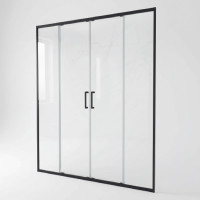
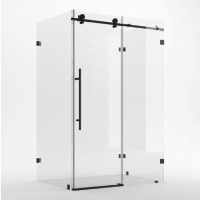
The Hamilton carries two panels of 3/8 in. certified tempered glass on exposed rollers — the frameless look depends on glass that can stand up for itself.
In short: Match the thickness to how the glass is supported. 1/4 in. (about 6 mm) glass belongs in framed and semi-frameless doors, where metal carries much of the load; 5/16 in. (about 8 mm) is a sturdier step up used on some hinged and tub doors; 3/8 in. (about 10 mm) is the usual choice for frameless doors and fixed panels; and 1/2 in. (about 12 mm) is a premium upgrade for very wide, tall or minimally supported custom glass. Thicker glass is stiffer and feels more solid, but it is heavier — roughly 3, 4, 5 and 6.5 lb per square foot — so the hinges, rollers and wall anchors must be rated for it.
- Thickness follows the support system: more frame, thinner glass; less frame, thicker glass.
- A 30 x 74 in. panel weighs roughly 46 lb at 1/4 in. and about 77 lb at 3/8 in.
- Glass and hardware are a matched pair; never swap thicknesses on hardware built for another.
- Read listings carefully: "3/8 in. of adjustability" is not the same as 3/8 in. glass.
- Whatever the thickness, look for tempered glass certified to ANSI Z97.1 and 16 CFR 1201.
01 — The Four Sizes
What are the standard shower glass thicknesses?
Four numbers cover nearly every glass shower door you will shop for: 1/4, 5/16, 3/8 and 1/2 inch. They're nominal sizes, which is why listings pair them with rounded metric figures — 6, 8, 10 and 12 mm. VIGO's own titles do exactly this, describing glass as "3/8 in. (10mm)" or "5/16 in. (8mm)".
The difference between the thinnest and thickest is only about a quarter of an inch, which sounds trivial until you lift a panel. Here is how the four compare side by side, using approximate weights published by glass fabricator Bendheim:
1/4"
About 6 mm
The framed-door thickness.
Typical use
Framed and semi-frameless sliders and screens, where channels and frames carry much of the load.
Weight
About 3 lb per sq ft.
Feel
Light; relies on its frame for rigidity.
5/16"
About 8 mm
The quiet middle child.
Typical use
Some hinged frameless shower doors and tub doors, plus framed and semi-framed kits.
Weight
About 4 lb per sq ft.
Feel
Noticeably sturdier than 1/4 in. on a swinging door.
3/8"
About 10 mm
The frameless workhorse.
Typical use
Frameless sliding and hinged doors, fixed panels and glass enclosures.
Weight
About 5 lb per sq ft.
Feel
Solid, with the substantial look most people picture as "frameless".
1/2"
About 12 mm
The heavyweight.
Typical use
Custom-fabricated panels that are very wide, very tall or minimally supported.
Weight
About 6.5 lb per sq ft.
Feel
Monolithic; needs heavy-duty hardware and solid framing behind the wall.
All four are made as tempered safety glass for showers. The federal safety standard 16 CFR 1201 lists shower doors and enclosures and bathtub doors and enclosures among the products it covers, so certification matters more than any thickness on the tape.
02 — Weight
How much does shower glass weigh, and why does it matter?
A lot more than it looks. Glass weight scales directly with thickness, so moving from 1/4 in. to 3/8 in. adds roughly two-thirds more weight to every panel, and 1/2 in. more than doubles it. Taking Bendheim's per-square-foot figures and a typical 30 x 74 in. door panel (about 15.4 sq ft), the arithmetic looks like this:
Those numbers shape everything around the glass. Hinges and pivots on a swinging door hold the full weight cantilevered off one edge. Rollers on a slider carry it along a rail. Clamps and channels on a fixed panel transfer it into the wall, which is why glass retailer Dulles Glass notes that 1/2 in. panels call for heavier-rated hardware anchored into solid framing. Weight also explains why a door designed for one thickness should never be fitted with another: the clamp gaps, channels and roller loads are all sized around a specific panel.
It changes installation day, too. A 77 lb panel is a two-person lift by any sensible standard, and every panel deserves gloves, padded blocks and patience. Follow the product's own installation manual, and call a licensed installer or glazier for heavy custom glass or an opening that isn't square.

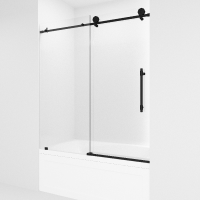
The Luca uses clear 3/8 in. certified tempered glass, pre-drilled for its vertical bar handle — drilling that has to happen before the glass is tempered.
03 — By Door Style
Which glass thickness does each type of shower door use?
The less metal around the glass, the thicker the glass tends to be. Dulles Glass sums up the convention for fixed panels: most use 3/8 in. tempered glass, 1/2 in. is the premium upgrade, and 1/4 in. is used in framed or semi-framed setups rather than frameless ones. Doors follow the same logic, and the VIGO range shows it neatly — every thickness below is taken from that product's own description.
- Framed doors: 1/4 in. The Satro Framed Sliding Shower Door frames clear 1/4 in. certified tempered glass in aluminum, so the frame does much of the structural work.
- Semi-frameless and light frameless sliders: 1/4 in. The Satro E-Class semi-frameless double slider and the Amada Frameless Sliding Shower Door both use clear 1/4 in. certified tempered glass, guided by top and bottom rails.
- Hinged frameless doors: 5/16 in. or 3/8 in. The Rochelle and Powell hinged frameless doors use 5/16 in. (8 mm) certified tempered glass, as do the Meridian Hinged Shower Door and the Orion tub door. The Pirouette pivot door steps up to 3/8 in.
- Frameless sliders: 3/8 in. The Luca and Hamilton both use 3/8 in. certified tempered glass, hung on exposed or top rollers with nothing framing the panel.
- Enclosures and fixed screens: 3/8 in. The Elan Winslow enclosure uses four panels of 3/8 in. tempered glass, and the Meridian Zenith semi-framed tub screen offers clear or fluted 3/8 in. tempered glass.
- Heavy custom glass: 1/2 in. Mostly the territory of made-to-measure panels for very large or minimally supported openings.
If you're still deciding between frame styles, our comparison of framed, semi-frameless and frameless shower doors covers cost, cleaning and look in more depth.
04 — Feel and Cost
Is thicker shower glass worth paying for?
Only if the door design needs it, or you can feel the difference and value it. Thickness is not a quality score on its own; it is one half of a matched system. A well-built 1/4 in. framed door is a sound, sensible product, and a 3/8 in. panel on poorly chosen hardware is not an upgrade.
What thicker glass does give you is stiffness. Grab the handle of a frameless hinged door and swing it: thinner glass can flex slightly at the free corner, while thicker glass moves as one piece and closes with a reassuring, solid sound. Thicker edges also catch the light more, which is part of the substantial, architectural look people pay frameless prices for.
On cost, thicker glass is more material, heavier to ship and needs stronger hardware, so prices rise with it; Dulles Glass describes 1/2 in. as significantly more expensive than 3/8 in. Within the VIGO range, the framed Satro starts from $359.90 with 1/4 in. glass, the Rochelle from $799.90 with 5/16 in. glass and the Luca from $759.90 with 3/8 in. glass. Glass isn't the only thing behind those numbers, though — finishes, adjustment systems and roller design all play a part, so compare whole doors, not just millimetres. For full installed budgets, see our shower door cost guide.

Frameless sliding glass like the Cass Elan: the panel's edge is on show, so thickness becomes part of the design.
05 — Choosing
How do you choose the right glass thickness for your shower?
Start from the door style you want, then check the opening and the wall. Three questions get most people to the right answer:
How to read a listing. Look for the glass thickness in the title or description, ideally in both inches and millimetres. Make sure the number actually refers to the glass: descriptions often quote adjustment ranges in the same units — "3/8 in. of adjustability" or "up to 1/8 in." of roller alignment — and those say nothing about how thick the panel is. Confirm the glass is tempered and certified to ANSI Z97.1 and 16 CFR 1201. And measure first, because tempered glass cannot be cut, drilled or trimmed after tempering; our shower door measuring guide shows how to take the three widths and the height that matter.
Featured in this story
One for every thickness on the tape
Satro Framed Sliding Shower Door
Clear 1/4 in. certified tempered glass framed in aluminum, with double-sliding entry from either side.
From $359.90
View product
Rochelle 47 1/4 to 48 3/4 in. W x 74 in. H Hinged Frameless Shower Door in Chrome with 5/16 in. (8mm) Clear Glass
Thick 5/16 in. (8 mm) certified tempered glass on an outward-swinging hinged door with Flex-Sizing.
From $799.90
View product
Luca Frameless Sliding Shower Door
Clear 3/8 in. certified tempered glass, pre-drilled for the bar handle, with LockTrack anti-jump rollers.
From $759.90
View product
Hamilton Frameless Sliding Shower Door
Two panels of 3/8 in. certified tempered glass on two-wheel exposed rollers, for 56 to 60 in. openings.
From $1,079.90
View productShop these categories
Explore the rangeShower Doors
Framed, semi-frameless and frameless doors, with the glass thickness on every listing.
Shop Shower DoorsFrameless Shower Doors
Sliding, hinged and pivot doors built around thicker tempered glass.
Shop Frameless Shower DoorsReference
Questions, answered
Is 3/8 inch glass better than 1/4 inch for a shower door?
It is stiffer and heavier, which suits frameless doors, but it isn't automatically better. A framed door designed for 1/4 in. glass works well because its frame supplies the rigidity.
What thickness is frameless shower glass?
Most frameless doors and fixed panels use 3/8 in. (about 10 mm) tempered glass. Some hinged frameless doors use 5/16 in. (about 8 mm), and very large custom panels may use 1/2 in. (about 12 mm).
Is 5/16 inch glass thick enough for a frameless door?
It can be when the door and its hardware are engineered around it: VIGO's Rochelle and Powell hinged frameless doors, for example, use 5/16 in. (8 mm) certified tempered glass. Never fit a different thickness to hardware designed for another.
Can I put thicker glass in my existing shower door hardware?
No. Hinges, clamps, channels and rollers are sized for a specific glass thickness and weight, so thicker glass may not fit or may overload them. Replace the door as a matched system instead.
How do shower glass thicknesses convert to millimetres?
Listings round the nominal sizes: 1/4 in. is about 6 mm, 5/16 in. about 8 mm, 3/8 in. about 10 mm and 1/2 in. about 12 mm.
Should heavy glass be installed by a professional?
Every glass panel is a two-person lift, and heavy or custom glass is best left to a licensed installer or glazier. Whatever you choose, follow the product's own installation manual and make sure wall anchors reach solid framing.
Further reading
Pick the door, and the glass follows
Decide how much frame you want, check the opening and the wall, then choose a door whose glass and hardware were made for each other.


